You Can Explain the Pattern and It Still Runs
Understanding rarely changes a pattern on its own. Here is what reaches an old pattern instead, when it can change, and how far the evidence goes.


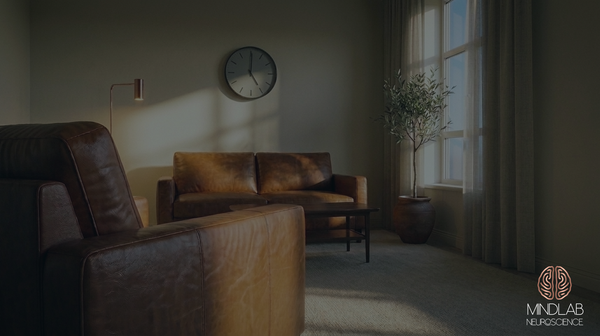
Someone asks a question about a decision you made. Nothing hostile, just a question, and already your face is warm and you're explaining too much, too fast. Somewhere behind the words, a calmer part of you is watching it happen and naming it: here it is again.
You could give a talk on where this comes from, and in a way you have, on long drives. You understand this pattern better than almost anything else about yourself, and it runs anyway.
Most attempts to change rest on one belief: understand why you do something, and the why will loosen its grip. Even the next step, deciding to change, carries less weight than people expect. When experiments succeed in changing people's intentions, their behavior shifts only about half as much as their intentions did.
Nothing is wrong with your understanding. Most of it sits in a different part of the brain from the pattern it is trying to change. So the question I take to a pattern is when it can be reached.
What Runs the Pattern
Three parts of the brain carry most of this story.
The prefrontal cortex, just behind your forehead, holds reasons and plans, including a new response you have decided on. It works best when you're alert but not overwhelmed, and high stress weakens it quickly.
The amygdala is a pair of almond-shaped clusters, one deep in each side of the brain. It works like an alarm, flagging what looks threatening and helping decide which emotional moments get kept.
The striatum, another paired structure deep in the brain, runs routines you've repeated so often that they no longer need a decision. Talking fast when you feel questioned may be one of them.
Your understanding leans on the prefrontal cortex. The pattern runs mostly on the amygdala and the striatum, which are far older than language.
Put the scene back together. When that warm, hurried feeling climbs high enough, that stress weakens the region your understanding leans on, and tends to strengthen what the alarm takes from the moment. Your understanding is still there, turned down at the moment you would want it.
In Optimizing Behavior Change: Addressing Neurological Resistance I mapped the systems that compete whenever you try to change. One of them I have not covered here: the reward system, which undervalues a payoff it has never felt. The article also covers why an old behavior keeps its advantage long after you have decided against it, and what a new one asks of the prefrontal cortex:
Old behaviors persist because they are neurologically efficient. They have been rewarded repeatedly. They feel effortless. New behaviors, by contrast, feel exhausting because they lack this learned reward history and require sustained prefrontal engagement.
When an Old Pattern Can Change
If understanding reaches the pattern so weakly, what does reach it? A reaction learned by repetition behaves in some ways like a memory, and for a long time the working assumption was that a memory, once stored, was fixed. Then a study in rats, published in 2000, found that a learned fear called back up had to be stored again in order to last. For a short while, it could be changed. Later work added a condition. Calling a memory up is not enough by itself. The memory seems to open when something in the moment does not match what it predicts.
Think of the whole reaction, alarm and all, as an old smoke alarm that has learned to go off at toast, with the rush of words as the extinguisher you reach for every time. You can know it's toast. You can explain why the alarm is oversensitive and who installed it. Then one day it goes off, the extinguisher stays on the wall, and nothing burns anyway. That is what an alarm like that learns from.
This is where I think the evidence points. An old pattern is most open to change while it is running. Two things have to be true in that moment. You manage a different response, and what follows does not match what the pattern predicted. Whether either of them lands depends on the state you are in. For you, that means stopping partway through your answer to ask what prompted the question, and the thing the pattern braced for never arriving.
The Crack in the Evidence
Most of the work I am drawing on here was done in animals, on learned fear, and a well-worn routine like yours may not reopen the same way. In 2010, a well-known study in people called up a learned fear shortly before training meant to undo it. The researchers reported that the fear was then less likely to come back. When an independent team ran the key test again, carefully and at scale, no benefit appeared. A later repeat of the animal version of the same procedure found none either.
Those failures land on one particular recipe for putting that short opening to use. They do not touch the finding underneath it, that a recalled memory can turn briefly changeable, which came out of a different kind of experiment. I stop short of saying a pattern can change only while it is running. In people it is still an open question, both whether that opening happens at all and whether it can be put to use on purpose.
The Moment to Aim For
Last issue was about keeping a correction small enough to survive a bad week. This one is about when to make it, and my work is organized around that. Real-Time Neuroplasticity™ is a name about timing. I put the work inside the stretch of time while a pattern is running, because a plan made days later, with the heat long gone, has so much less to work with. It does not mean anything is changed for good on the spot. A change made once is fragile, and what lasts is built slowly, across many repetitions.
Because the prefrontal cortex weakens once stress runs high, the moment to move is early in the reaction rather than at its peak, while you can feel it starting and still have a say.
Catching the reaction early is what I work on with people, and that work begins with a Strategy Call. The call is one hour, by phone, and I will tell you what I see.
So the next time a question like that lands and the heat starts, use your understanding to recognize it early. Then try one different thing, even a pause, and notice what happens next. It will feel like very little. As far as the evidence goes, it is the kind of moment an old pattern can learn from, and you will need many of them.
Dr. Sydney Ceruto