Catching an Emotion Before It Decides for You
The feeling behind your unsent text started minutes earlier, with what a friend's empty chair seemed to say about you.


You're at a table for two, twenty minutes past the time you agreed on, and the other chair is still empty. There's no message. At minute five you were watching the door. By minute twelve you were remembering the last time this happened, and the time before that. Now your jaw is tight, you've read the same line of the menu four times, and a text sits typed on your phone, not yet sent: Don't bother.
Then your friend comes through the door, out of breath and apologizing. Their train sat in a tunnel for half an hour with no signal. You believe them. You say it's fine. The chill stays in your voice for most of dinner anyway.
The evening turned at about minute twelve, well before the door opened, when an empty chair started to say something about how much you count to this person. The feeling grew out of that meaning, and it was in your voice before your friend had finished apologizing.
The usual advice arrives later still: calm down, talk it through once you can think straight. Changing the meaning while the feeling is still climbing is a different move, and it has a name, cognitive reappraisal. It's one of the most studied things people do with an emotion.
What a Feeling Is Built From
Emotion researchers often describe a feeling as something built in steps. Something happens. Your attention lands on part of it. That part gets a meaning, and the feeling, along with whatever you do next, grows out of the meaning. Reappraisal works on that meaning. Keeping a straight face works at the very end, on your expression, after everything underneath has already happened.
The difference shows up in the body. In a 1998 study, 120 people watched a film chosen to disgust them. Some were asked to think about it in a way that would leave them feeling nothing. Others were asked to hide what they felt, so that anyone watching would not know. Both looked calmer than a third group who simply watched the film. The first group also reported less disgust. The second group's bodies showed more of the fight-or-flight activity that comes with stress.
Something like that happened at dinner. You said it was fine, and your face may even have agreed. You believed the train story, but the meaning underneath never changed, so the feeling kept running and set the tone for the evening.
The Picture From 48 Studies
When researchers pooled 48 brain-imaging studies of reappraisal in 2014, the same pattern kept appearing. Behind your forehead, activity rose in the parts of the prefrontal cortex that hold a thought steady and trade one idea for another. It also rose in parts of the temporal lobes, which sit along the sides of the brain above the ears and handle what words and situations mean. And the amygdala, a pair of almond-shaped clusters deep in the brain that help set how strongly you react, quieted down.
The researchers took this to suggest that those front regions work by changing what a situation means, and that the amygdala responds to the new meaning. At your table, the meaning that arrived at minute twelve was that you don't count. A second one was available the whole time, a stalled train or a phone that had died.
My article Cognitive Reappraisal: Why Positive Thinking Backfires takes up another thing people try at a table like that, forcing a cheerful thought on top of the feeling. One passage there follows the same moment into an office:
The challenge in workplace situations is that the emotional response often drives behavior before reappraisal can engage. A person reads a critical email, experiences an amygdala-driven threat response, and responds defensively, all within the time window before the prefrontal cortex can generate an alternative interpretation.
Why Early Is Easier
In Issue 8 I wrote that once stress climbs high enough, it turns down the prefrontal cortex. Reappraisal leans on that same region. In a 2013 study, people learned in a lab to fear one particular signal, because something unpleasant followed it. Then they were taught a way of thinking differently about the signal. The next day, one group went through a stressful task before trying the technique again, and the other did not. In the calm group, fear responses came down. In the stressed group, they did not come down.
The best moment to rethink the empty chair was around minute twelve, while the meaning was still forming and the part of your brain that could write a different one was working well. Twenty minutes in, with Don't bother typed and waiting, you'd be asking for that rethinking from a region the feeling had begun to turn down.
The move itself can be small. You notice the meaning as it arrives and let a second reading in beside it. Sometimes the first reading is the accurate one. A friend who is late every time may be telling you something true, and that calls for a conversation, later, when you can have it well. The rethinking I mean is for the moments when the meaning has run ahead of what you know.
How Much One Moment Can Do
A reappraisal made early can change how that one evening goes. The change is real, and it can fade without leaving anything behind. Whether the next empty chair lands any differently is a slower matter. That slower change is built across many moments like this one, if it is built at all. And most of the research I have described worked with feelings the researchers created in a lab minutes or days earlier. A feeling about being kept waiting carries more history than any of those.
My method, Real-Time Neuroplasticity™, is aimed at moments like minute twelve, in the rising part of a feeling.
Working with me on those minutes begins with a Strategy Call. The call is one hour, by phone, and I will tell you what I see.
Think of the last time you said it was fine and heard the chill in your own voice. How long before that had the meaning arrived?
Dr. Sydney Ceruto
|
|
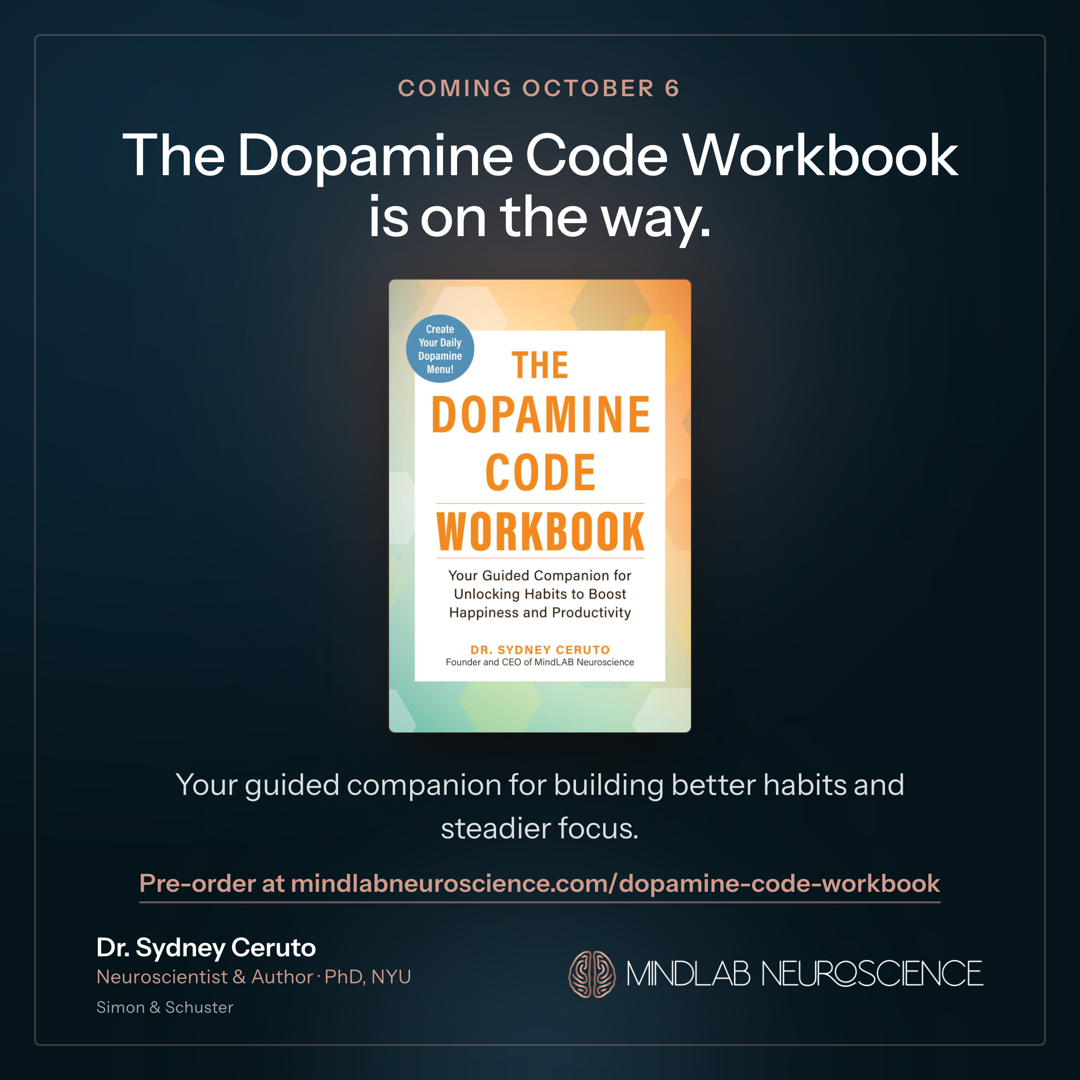
The Dopamine Code Workbook
The hands-on companion to my June book: six chapters, mostly exercises, including a Dopamine Menu of your own.
Pre-order now →
|