Why Do I Say No Without Thinking?
Rats trained long enough keep pressing a lever for sugar they've learned to dislike. Some of your quickest answers may work the same way.

You're being asked to say yes to something you've never done before, by someone who knows you well. Before they've finished asking, you've said you'll think about it. It's what you say to every invitation like this, and you both know it usually means no.
We tend to picture a decision as a weighing, with the options on a scale and a verdict at the end. A lot of choices never reach the scale. The answer is looked up rather than worked out, and it comes from whoever you were when you first learned it. Yours may date from a time when saying yes to something new could have gone badly.
In this issue I explain how the brain stores an answer like that and keeps reaching for it, and I end with one question to ask while the choice is still open.
Two Ways the Brain Chooses
One way the brain settles on an answer reuses the past. Deep in the brain, the striatum keeps something like a running score for each response you might give in a familiar situation, raising it when that response paid off and lowering it when it cost you. The cells that make dopamine lower down, in the midbrain, keep the score current: they fire harder when an outcome beats what the score predicted and dip when it falls short. When the situation comes around again, the highest-scoring response is simply there, often with no feeling of having chosen it.
The other way works out what the options are worth now. The orbitofrontal cortex, the part of the frontal lobes just above your eyes, weighs each option against what you want today. It's slower, and it takes effort.
Usually the two agree, and the fast one spares you an enormous amount of work. A brain that had to reason out every choice from scratch would never get through a morning. The trouble starts when your situation has changed and the score hasn't.
What Rats Show About an Answer You Always Give
The plainest demonstration comes from rats. In experiments published in 1982, hungry rats learned to press a lever for sugar, and then were taught to dislike the sugar by making them feel sick after eating it. Rats that had earned sugar at the lever for only a short time pressed it less afterward. Rats that had earned it there for much longer kept pressing for a sugar they had learned to dislike. Their choice was still coming from the old score.
If the rats are any guide, a response you always give is never tested against the present, so its score has no reason to change, and it comes up first again. Your answer to invitations like this has been scored for years on what holding back spared you, and never on what saying yes might have brought.
I wrote about the fast answer, the one that arrives as a gut feeling, in an article on when it deserves your trust.
In domains where you have significant experience, gut feelings are often more accurate than deliberate analysis because the brain rapidly matches patterns from accumulated knowledge. In unfamiliar domains, intuition is less reliable and should be supplemented with structured reasoning and external data.
For that rule of thumb, a changed situation is the hard case, because it can arrive wearing an old one's clothes. This invitation looks like every one you've turned down. What has changed doesn't show: since you learned that answer, you've come through harder things than this, and the person asking is someone you trust. The stored answer knows none of that.
How Stress and Distraction Favor the Old Answer
In a 2009 study, some people first held a hand in ice water while being watched and filmed, a common way to stress people in a lab. Then everyone learned two actions that each won a different food, and afterward had as much of one of the foods as they wanted. People spared the ice water moved away from the action for that food. People who'd been through it kept choosing both about equally, as if nothing had changed.
A later experiment found something similar when people had to keep track of a second task while they chose. That's often your state when an invitation like this comes, with your mind still half on whatever you were doing.
The evidence rests mostly on animals and on simple choices about food. In people, five attempts to recreate that rat result through longer training alone failed, and nobody has tested a real-life decision this way. What I take from it is a direction: under pressure, the stored answer tends to get more of a say.
One Question to Ask Before You Answer
The work I do sits at the point where the stored answer arrives. It shows up fast and feels like knowing, which is what makes it hard to question. So the first skill is noticing the speed: an answer that lands before the question is finished is likely coming from the score. The second is one question in the present tense, asked while the choice is still open. What is this worth to me now?
Sometimes the old answer survives that question, and then you give it knowing why. Sometimes the question buys you room for something closer to what you want, even if it's only a yes with one condition attached.
One answer checked this way doesn't rewrite the score. It adds one new outcome to a record that took years to form, and the old answer will probably keep arriving first for a good while. A score shifts for the long term only over a sustained run of new outcomes, and it learns mainly from what happens after you choose. I believe it matters when those choices are made as well as how many there are, though that hasn't been tested yet. That belief is why Real-Time Neuroplasticity™, the method I built, does its work in the moment you're asked, before the answer is out.
That work begins with one hour with me, by phone.
Most of your stored answers deserve their speed. The ones worth a second look are usually those you give before anyone has finished asking, in situations that have changed since you learned them.
Dr. Sydney Ceruto
|
|
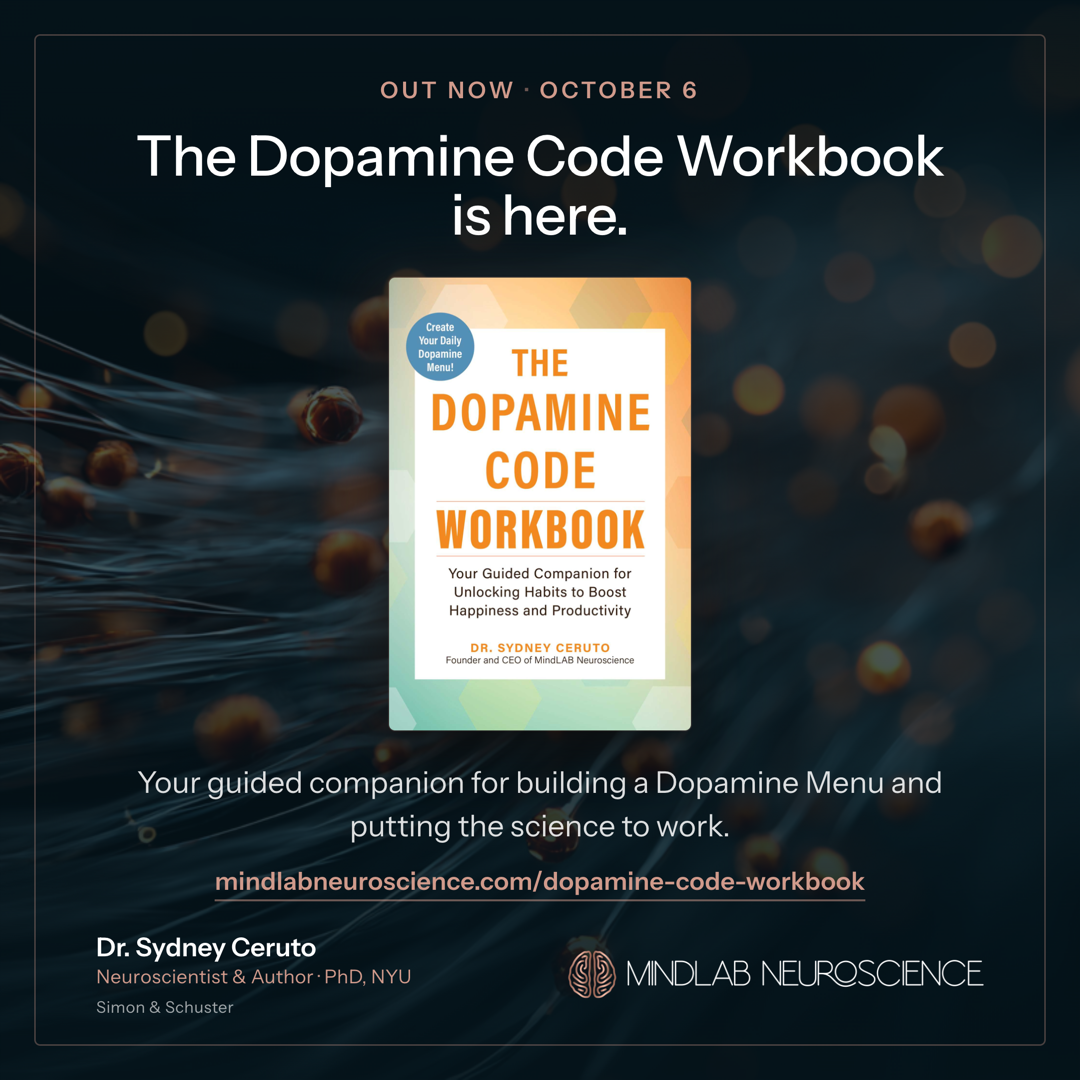
The Dopamine Code Workbook
The companion to my June book, where you start with the rewards you already lean on and write the Dopamine Menu you would rather have.
Order now →
|